
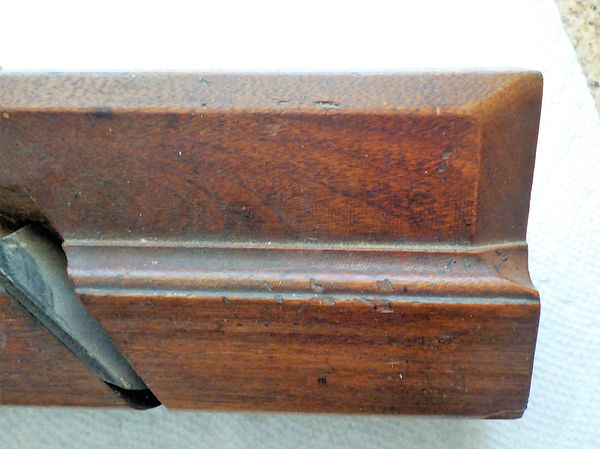
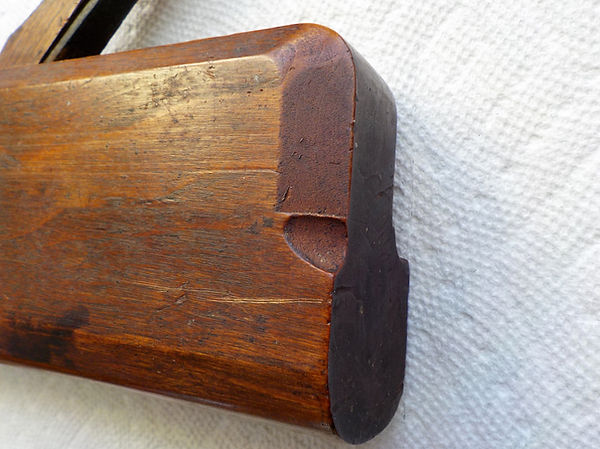
9 1/2" long molders and a 9 1/2" long rabbet
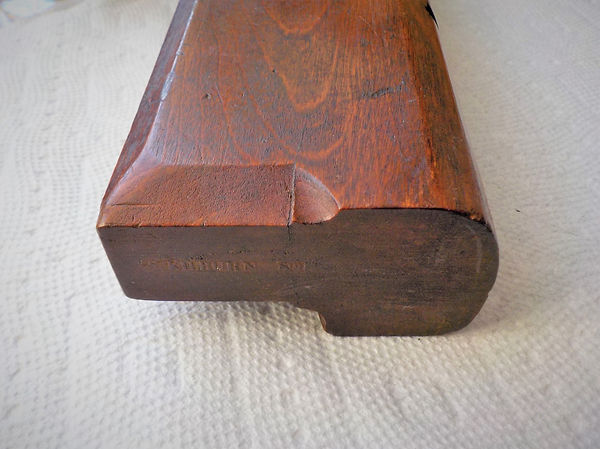
3/8" flat body chamfers on the molders and heavy round chamfers on the rabbet body. 1/2" flat chamfers on ends. Chamfers end with a step and a bold gouge cut. Early style relieved wedges. Molders have shoulders with a molded edge. All found in MA (separately over several years).
-
Tom Whalen provided the photographs and research material on Samuel Kilburn from Wilbraham 1731-1809 (2023)
-
Samuel Kilburn Jr 1777-1835 from Lunenberg, MA and Fitzwilliam, NH research by the editor (2026)
-
Editor's assessment of the planes and the current candidates.
S. Kilburn No
Samuel Kilburn
Housewright/Joiner
by Thomas Whalen
Looking at the platemakers stamp of Samuel Kilburn, to the right of the name are the letters No with two small dots below the o.. What do the letters mean? To a researcher the first thing that comes to mind is a town or a location. I set my course in that direction. Most of the towns starting with an N are in Franklin, Hampshire and Worcester County, s The towns included in my research were Northampton, Northborough, Northfield, Norwich, and Northbridge.
I have three S. Kilburn planes in my collection, two have characteristics of 18th century American wooden planes. I turned to the Massachusetts 1790 census searching for S. Kilburn in the towns and counties listed above. After many hours of research on the web with little progress I began to question if the No.. marked on the planes were representative of a town or a location.
In my research a Samuel Kilburn of Wilbraham Ma. popped -up several times on the Net which I discounted based on the location. I decided to set my sights on Kilburn in Wilbraham.
Based on my research, I was surprised that Kilburn of Wilbraham was a housewright and joiner. Is he the maker of the planes marked S Kilburn? I believe so.
Samuel was born in Monson Ma. on September 13, 1731. He was living in Brimfield in 1740, so Samuel returned to Brimfield in 1757 to marry Abigail Colton on August 11, 1757. Samuel and Abigail located in Wilbraham in 1772 where he established a joiner’s shop. Samuel died on January 1, 1809. Samuel bequeathed the shop and his tools to his oldest son Jonathan, also a joiner.
The Probate Records of February 2, 1811, Inventory & Values list the following items.
Grindstone $1 2 axes $1
1 fine saw.75 1 joiner .50
1 joiner $1 1 joiner .30
1 joiner $1 1 smooth plane .35
10 moulding planes $2.50 2” augur .25
1 smooth plane .66 1 chisel .12
1 bitstock .75 1 great wheel .75
2 files .25 1bench dog .66
3 narrow chisels $1.18 1 knife .06
1 key saw .10 1gage .12
1 saw $1.50 1 rule measure .12
Each of the planes in my collection were found in three separate locations in Massachusetts. The first find was a 1 5/8” hollow, years later, what appears to be a matching round plane to the hollow. The planes separated for years are now back together again.



Samuel Kilburn 1775 - 1835 Lunenberg, MA and Fitzwilliam, NH, housewright
Deeds and probate documents present Samuel Kilburn 1775 -1835 as a possible / alternative candidate, despite the relatively late dates for this craftsman. (The editor's research 2026)
1798 court document, Samuel Kilburn, Lunenberg, Worcester, MA, housewright
1801, 1804, 1812, 1820 and 1830 deeds, Samuel Kilburn, Fitzwilliam, Chester, NH, housewright and carpenter
1835 detailed probate inventory
1798 court document, Samuel Kilburn, Lunenberg, Worcester, MA, housewright

1801 deed, Samuel Kilburn, Fitzwilliam, NH, housewright


1835 probate inventory excerpt, Samuel Kilburn, Fitzwilliam, Chester, NH.


The editor's working notes on the three known planes and the craftsmen candidates known to date.
It is the editor's assessment, that neither the Samuel from Wilbraham nor the Samuel from Fitzwilliam fit well with the three known planes .... from a date perspective or a plane detail (region of manufacture) perspective.
Assessment of the planes. The planes are somewhat of a contradiction in 18th C construction details... ie early features as well as later features.
The wedges look as though they were from the 1760s in the area surrounding Wrentham, MA. (Early to mid period Ce Chelor and also J Leavitt (two possible MA candidates starting ca 1760s.)
The molded shoulder and chamfer stops also fit the Wrentham area, but from a date closer to 1780. These two elements can be seen on "late" planes made by both Cesar Chelor and John Nicholson ... but on molders still in the 9 3/4 to 10" length range.
The 9 1/2" long birch hollow and round have flat chamfers while the 9 1/2" long birch rabbet, has heavy round chamfers on top of the body. The rabbet plane seems to be from a 1795/1810 date, while the hollow and round pair are earlier.
Neither the Wilbraham Samuel nor the Fitzwilliam Samuel fit well with the plane elements cited above ... the Wilbraham Samuel being too early and the Fitzwilliam Samuel being somewhat late.