
R Ionson
1st tier candidate:
-
Rufus Johnson b ca 1760 - d 1822
believed from Litchfield Co., CT - Harwinton, CT by 1777 - Pompey, Onondaga, NY by 1803
RW 1777 in Capt. Aaron Foot's Co., CT militia
m Mary Butler 1784
1803 deed, from Harwinton, CT, joiner, to Pompey, NY
2nd tier (both are too late for the planes)
-
Reuben Johnson b 1796 - 1850 -
1827 deed, Winchenden, MA and 1835 Leominster, MA, carpenter
-
Robert Johnson b 1807 - 1850 -
1835 deed Chesterfield, Chesher Co., NH, cabinet maker

R Ionson
1st tier candidate
-
Rufus Johnson b ca 1760 - d 1822
believed from Litchfield Co., CT - Harwinton, CT by 1777 - Pompey, Onondaga, NY by 1803
RW 1777 in Capt. Aaron Foot's Co., CT militia
The widow Mary applied for a RW pension knowing Rufus enlisted from Harwinton, CT and was in the RW for roughly 3 years. She was unsure of the details and as a result, officials debated his record through 1847. The DAR Lineage Book, Vol 20, 1897, lists her husband Rufus as having been in Aaron Foot's Co., in 1777. (The DAR is known for it's documentation requirements.)
m Mary Butler 1784
sons Rensselaer (b 1787), Rodney (b 1790) and Russell (b 1793) were recorded in his pension application
1803 deed, from Harwinton, CT, joiner, to Pompey, NY
1790 and 1800 US census in Harwinton, CT, 1803 tax, 1810 and 1820 US census in Pompey, NY
d 1822 in Pompey, NY
(Discussions with Tom E. and Mike H. did not find a conflict between 1) the estimated plane dates and Rufus Johnson starting his trade following his RW service in ca 1780 and 2) Rufus apprenticing and starting his trade in Litchfield Co., CT.)
2nd tier candidates (too late for the planes)
-
Reuben Johnson b 1796 - 1850 -
1827 deed, Winchenden, MA and 1835 Leominster, MA, carpenter
-
Robert Johnson b 1807 - 1850 -
1835 deed Chesterfield, Chesher Co., NH, cabinet maker
Here is Mike Humphrey's 4-10-26 assessment of the R Ionson candidates.
"I agree that Reuben is too late, unless his planemaking styles were very anachronistic [unlikely]. Rufus was born on the early side, but was a working joiner when the planes were likely made. There are enough R Ionson planes surviving that he must be considered a commercial maker, and there is enough variation in style features that he must have worked for a few years. True, there is a popular consensus that he was likely north of Massachusetts, but that could be incorrect. Straight west of Hartford is not unreasonable. He is known to have used some exotic woods, and the Connecticut River could have been the means of access in either location. There were a number of makers in that general area, and their styles were all over the place; S Whilte, H Wetherel, H Wetherell, I Fitch, I Hitchcock and L Kennedy. [I presently have one R Ionson plane; a beautiful complex molder in rosewood, or some other dense, dark import. (Ed.: This plane is shown and discussed below.)] As an aside, I have long suspected that R Ionson and I Martin had some kind of influence, one on the other. That could be based on the idea that both were from the upper Ct River valley. Anyway, I’ll throw that out there. ..."
Rufus Johnson, RW pension review 1843.

Rufus Johnson, RW record edited from DAR Lineage Book, Vol 20, 1897.

Rufus Johnson, RW record. Record of Service of Connecticut Men in the War of the Revolution, 1812, Mexican War, 1889, pg 502 and 503.


Rufus Johnson 1803 deed, Harwinton, CT to Pompey, NY, joiner


Seven R Ionson planes. These toted planes are primarily maple, fruitwood and birch. These molders are 10" and made of beech.

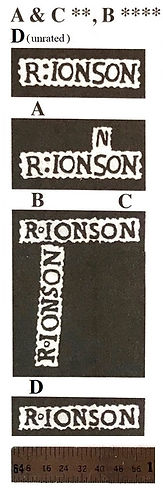
A Working R Ionson Imprint Sequence.
Based on available planes / plane images, the following imprint sequence ("early" > "mid" > "late") is proposed for a working R Ionson date / plane outline: D > C > A with the B imprint variant assumed to fall withing the same timeframe as the A imprint. The plane and imprint sequence seems to fit well with the candidate Rufus Johnson and his ca 1780 to 1820 working dates.
Characteristics of the planes with each imprint will be presented and examined in detail in the sections that follow.
(Note: Imprint "D" has been added to the GAWP5 imprint sequence for sake of clarity in this imprint / plane discussion. This is the imprint from the "early" toted molder. It is given an unrated rarity designation following GAWP5's nomenclature. Noting the orientation, this "D" imprint is not meant to be applied to the single stamped (vertical) C imprint variant which is found on narrow molders. Also, for use in this imprint / plane discussion, the R dot Ionson imprints include a modified "dot" based on a review of the mark.)
R Ionson toted molder. Single stamp R dot Ionson imprint with the designation of "D" to be used within this website's R Ionson entry. (It is not included in GAWP5). 12.5" long. The tote is offset and has an undercut heel. The flat body chamfers are 1/4" wide and have a pronounced shallow angle to the body, roughly 20 degrees. In contrast, in all but one plane with round chamfers, R Ionson planes have narrower flat body chamfers whose angle to the body is at less of an "incline" ... approximately 55 degrees.
Chamfer stops on the front end of the plane are formed by a step and turnout. Rear chamfers are flat and tapered without a separate stop. (The other known bench planes have only the tapered end chamfers at both the toe and the heel.) Birch body and cherry tote. While this toted example is earlier than the other open-tote bench planes, it shares the same tote outline, the same wedge design and the same cheek abutment chamfer design. (I Sleeper and N Little bench planes have a similar cheek abutment chamfer design.)


R Ionson "early" chamfer and chamfer stop on the toted molder (right) vs "mid" chamfer and tapered end chamfer on the small jack plane (left).

R Ionson "mid" jack plane. C imprint, 16" long, beech body, maple tote.

R Ionson "mid" narrow bead. C imprint variant is stamped only once with a vertical R dot Ionson due to its' narrow width. 10" long, beech. 1/8" flat chamfers end with a faint step and turn out on the reverse ends. Rounded wedge finial.


R Ionson narrow bead with inked size (?) on toe.

R Ionson narrow bead with iron matched to body via 4 dots and 4 slash marks respectively. The wedge is not marked.

R Ionson jointer. C imprint. 30" long, maple with birch wedge. 1/4" flat chamfers at 55 degrees to the body. End chamfers are flat and tapered without stops. (A second 30" jointer with a replaced wedge is known.)


R Ionson wedges from three "mid" 10", beech molders with the C imprint. The cutout under the relieved finial, while a bit shorter than the two rounded finial wedges, has the same shape / curvature. (The relieved wedge is not shown in GAWP5.) All three molders have 1/8" wide, flat body chamfers which end with a faint step and turn out on the reverse. (As previously mentioned, the narrowest of the three molders is only stamped once with the R dot Ionson.)
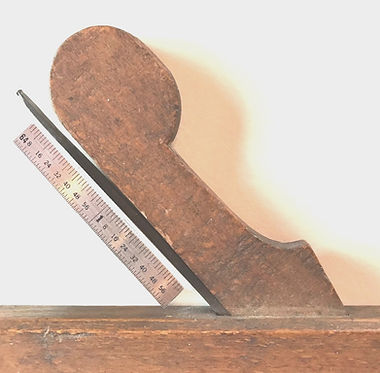


R Ionson "mid" molding plane. C imprint, 10" long, beech. 1/8" flat chamfers end with a faint step and turn out on the reverse ends. James Cam / Warranted iron appears original. It is the editor's opinion that the Warranted imprint on the iron planes might place the iron and therefore the plane into the 1800 to 1810 timeframe. Photos courtesy of Steve Frazier.

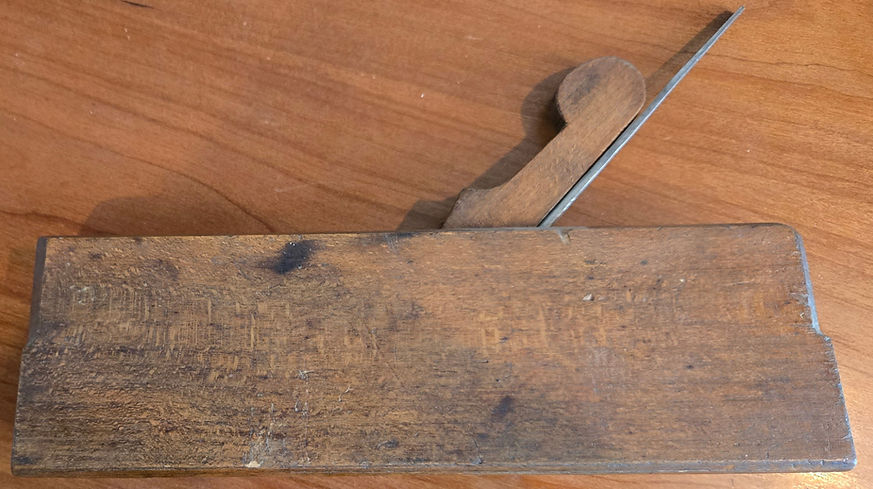


R Ionson molding plane. C imprint, 10 1/16" long, exotic wood ("a heavy, dense, dark wood…possibly rosewood"). Rounded chamfers end with a step and turn out on the reverse ends. Iron with an incuse Bishop imprint. Original wedge with a shapely artistic profile. This plane may represent a unique and one-off piece made in the later part of R Ionson's C imprint "mid" period. Photos courtesy of Mike Humphrey.

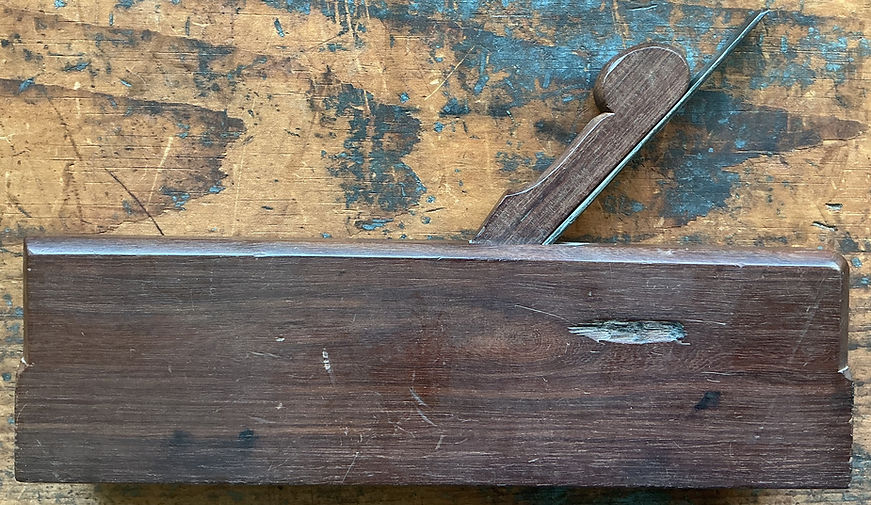


R Ionson "later" molding plane. A imprint, 9 1/2" long, beech. 1/8" flat chamfers end with a faint step and turn out on the side opposite the shoulder. Wedge with slight swept finial profile. Sketch courtesy of Tom Elliott.
