
Chamfer Stops with Flutes
MA, RI and CT - 1720 to 1800
Chamfer Stops with Flutes
This investigation began as a study on when and where fluted chamfer stops were used by Colonial and Federal craftsmen in the general timeframe of ca 1720 to ca 1800. It fits within the multi-decade effort by numerous researchers to better understand early plane detail patterns such as wedge outlines, tote shapes, shoulder patterns, wedge abutment chamfers in bench planes and chamfer stops. Within this larger context, it is hoped that major "schools" of craftsmen influence can be deduced ... such as Francis Nicholson, Henry Wetherel, John Sleeper, Joseph Fuller, John Walton, and Oliver Spicer, among others. IE.; Who apprenticed to whom, how the trends changed over time, how the trends moved over time.
Mike Humphrey, in CAWP issues 8 and 13, addressed chamfer stop definitions/styles as well as schools of influence and their impact upon regional plane construction details. In CAWP-8 Francis Nicholson's chamfer stops are described: "His wide flat chamfers ... come down the plane ends then turn out, usually distinctly, in a line that always tips down toward the center of the plane. After rolling up into a wave, they continue down to feather out and fade to the edge." Mike relates how Francis influenced John Nicholson, Cesar Chelor, Ballou, I Walton ... also H Wetherel in Norton. H Wetherel adapted Francis' flute design such that the stops "narrow at the point of the wave then widen again before tapering out." E Clark ... appears to have been the other maker ... who carried through with that style. "Wetherel's narrowing then widening" ... "later evolved into the popular flute."
In CAWP-13, Mike provided chamfer stop drawings as well as descriptions. Here are the examples that relate to flutes, noting that most of these forms relate to the early Wrentham craftsmen.

Various notes on the craftsmen with respect to their fluted chamfer stop designs.
1. John Nicholson’s early planes (believed to have been made when he was still in his father's shop) tend to follow his father's influence, including the fluted chamfer stop details. Once on his own, his planes tend to exhibit significant variation in the construction details ... including the chamfer stops. Unlike his father's stops, the stops on John's planes transitioned into a tipped step followed by a weak transition to a moderate/short curved turn out. (See the planes in the collection of Colonial Williamsburg.) The example shown reflects John's earlier stop form and is found on a plane with the A imprint. This was prior to his move to Cumberland in 1747.
2. Variability in chamfer stops were also seen with three other early craftsmen: I Walton, Ion Ballou and I Hitchcok. (These craftsmen started working ca 1730 to 1750.) While the stops are simpler and less refined, elements of Francis stops can still be seen; a tipped step, a sloped transition back to the heel, followed by an ill-defined, long fluted return.
3. Jethro Jones (I Iones) crafted "weak" flutes on some of his Holliston planes in the early 1770s. In addition, in his middle years, there's a few planes known which have a narrowed lamb's tongue form, the same form that is also seen on some of Chelor's early planes. (As a side note, while involved with and directly influenced by Cesar, Jethro did not seem to follow Cesar's chamfer stop style sequence.)
4. As mentioned, John Walton Jr. appears to have used "less refined" flutes on his early planes. Prior to the time his son John III was in training, he appears to have used a stop which was formed by step followed by a long taper. His last stop style was a step followed by a short turn out, similar to the form his sons John III and Benjamin used. (See the Reading chamfer stop trend image below.)
5. Joseph Fuller started out with a step and long taper on his chamfer stops, similar to the middle form used by John Walton Jr.. It is not known when he started used a fluted form, although it was rather early as he was still using his Jo (triple dot) Fuller imprint.
6. N Taber used a fluted form early in his craft. But, most of his planes used a later, simple turn-out chamfer stop form.
7. Fuller and Field planes were made starting in 1798 and had flutes, documenting that flutes were used right up to the end of the 18th century.
8. Benediah Dean planes exhibit construction trends that are rather complex and hard date with respect to his early work vs later work. (See the entry on B Dean planes.) Some of his early planes with flat chamfers do not have flutes while other of his planes have round chamfers with flutes.
Summary List of Chamfer Stops with Flutes
-
"Flute detail" descriptions are included by the editor as a means to distinguish and help describe the various design elements. The various "groups" may also be tied to different schools of influence.
-
"Dates" are mostly the life span of the craftsmen with few exceptions.
-
"Est'd start date" entries are the estimated dates that the craftsmen started to make marked planes with a flute. In most of the entries, these are the estimated dates that the craftsmen started their craft. In a few entries, these are estimated dates the craftsman started using flutes (eg Jo Fuller) or changed their style of flute. A few entries include estimated ending dates which tie to either their moving locations or to their no longer using flutes.
-
The named candidate/craftsman with dates represents a documented individual who can be reasonably attributed to body of marked planes.
-
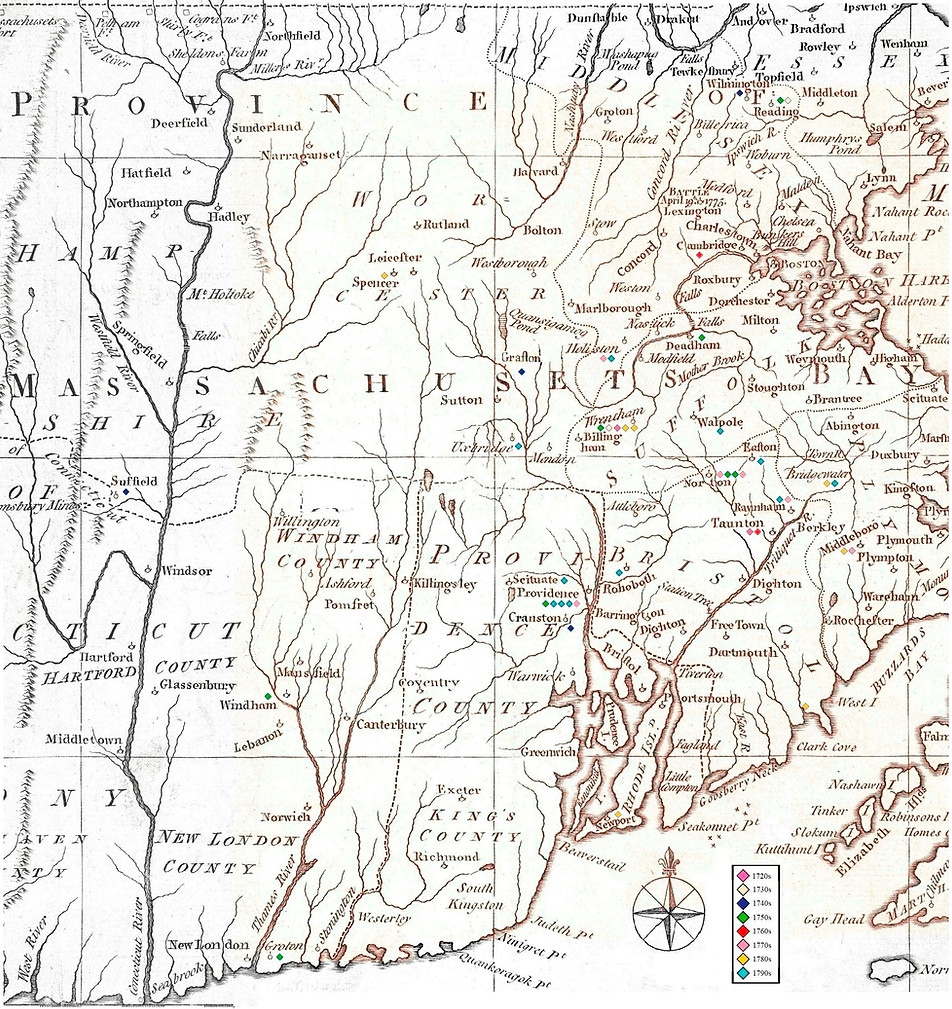
There are five entries where there are at least two craftsmen that are the possible makers of the planes and so specific dates are not provided. These craftsmen are not included on the map.
-
Two entries have no craftsmen associated with the planes, but the names are included on "the flute list".


A period map with distribution and starting date patterns for craftsmen who included flutes on their planes. (John Basset may have started his trade in Taunton, but moved to Norton within a year or two. His planes are marked Norton and his information on the map is tied to Norton.)(Francis Nicholson worked in Rehoboth before moving to Wrentham. His map information is tied to Wrentham.)
Chamfer stops with flutes.


Representative toe images.

Chamfer stops over time (with flutes) ... Wrentham, MA.

Chamfer stops over time (with flutes) ... Reading, MA.
