Abutment Cheek Chamfers -
Massachusetts and Rhode Island
Chamfer design change over the 18th C as observed with documented craftsmen.
April 2026, by Pat Lasswell
18thC American planemaking "design" is a blend of regional design differences (Upper NE, MA,/RI, CT, PA.), various schools of maker influence (eg Sleeper, Wrentham, Fuller, Pomeroy, Wetherel) and date (1700 vs 1750 vs 1800). Specifically, these design elements / traits involve the wedge outlines, tote outlines, chamfer styles and chamfer stop styles. (Molding plane length is also one of these elements, but one that's often influenced by the "maker's school".) Studies of these elements are made possible by having craftsmen who are well documented and who have each produced a significant output of planes over the course of their careers.
This website entry is one such study, albite one which is not usually considered. A series of MA & RI craftsmen, with examples of their planes that have a bench-plane escapement, are presented with the goal of tracking how wedge abutment cheek chamfers change over time. It is hoped that the lessons uncovered here can be used to better understand the craftsmen whose products are less well known or documented.
Andrew Adams, 1715 - 1782, Ipswich and Grafton, MA.
A Adams, large mark above. Wedge abutment cheek chamfers are narrow, straight and parallel. Mid 1700s.
Amos Adams, 1776 - 1849, Medfield, MA Salem, MA and Portland.
A Adams, small mark below. Wedge abutment cheek chamfers are narrow, tapered ellipses which extend to the wedge contact. No earlier than 1796.

A Adams large mark right. 1/4" flat body chamfers with flutes. The flutes with a lamb's tongue chamfer stop design are mostly found in SE MA ca mid 1700s as introduced by Francis Nicholson starting in the 1730s.
A Adams small mark left. 5/16" flat body chamfers that end with a step and turn-out. The chamfer stop design is common in New England by the 1780s and 1790s.
In general, in earlier New England smoothers (ca mid 1700s), the plane body footprint is shorter and less curved at the heel and the toe, and round top wedges are the common form.

Cesar Chelor, ca 1720 - 1783, Wrentham, MA, freed by Francis Nicholson in his will dated April 1, 1752.
Cesar's only known jointer plane, 31" long with his Ce Chelor / Living In / Wrentham mark. Offset tote, flat body chamfers which end with Cesar's late style chamfer stops ... a tapered stop with a simple turn out. See the plane gallery entry for CE Chelor planes. The wedge abutment cheek chamfers are tapered and flat with a "medium-wide" width. H Wetherel abutment chamfers are similar. A review of the Ce Chelor planes in Colonial Williamsburg's Nicholson / Chelor collection yielded nine planes with bench escapements, all with the "Ce Chelor / Living In / Wrentham imprint. The abutment chamfers were the same as seen on the jointer, noting that a couple of them were slightly narrower overall. Of these nine planes, three had body chamfer ends that were simple turn-outs, four that had lamb's tongue / flute stops and two with the late style body chamfer stops.


B Dean. Benaniah Dean, b 1754 d 1831, Raynham and Taunton, MA.
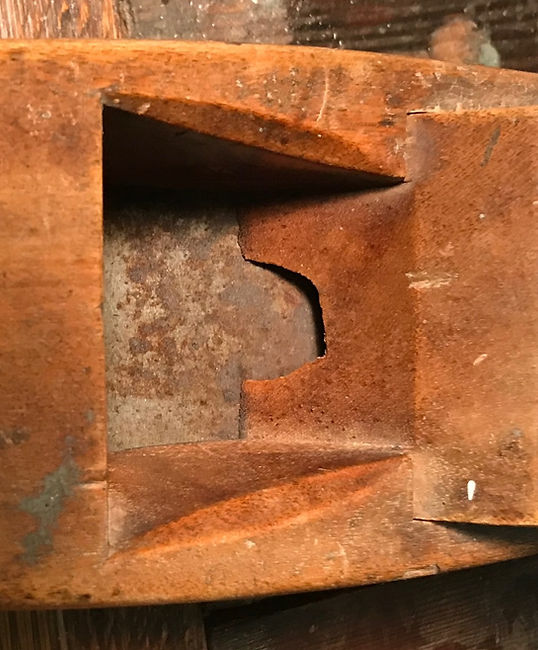
In the website's entry for B Dean, the difficulty of assessing early vs late Dean plane traits is presented. The abutment chamfers offer a possible tool that can be used to address this question. That entry states ... "However, the two planes with a bench escapement may provide an answer. The crown molder with flat chamfers and flutes (group 2) has wedge abutment cheeks with chamfers that are flat, wide and generally have parallel edges ... an early design seen in New England planes 1750 / 1780. With early planemakers that continue into the 1790s (Jo Fuller and E Clark being prime examples), these abutment chamfers narrow in height and develop tapers toward each end.... becoming more of a lens shape. The B Dean jack plane without flutes (group 1) has abutment chamfers that are "later", based on this comparison ... and thus the group 1 planes were probably made after group 2 planes." (Group 1 molders have non-relieved wedges, are 9 3/4 to 9 7/8" in length and have body chamfers that end with a simple turn out. Group 2 molders have relieved wedges, are 9 3/4 to 10" in length and have body chamfers that end with flutes.)
Early abutment chamfers above and later abutment chamfers below.


Jo Fuller. Joseph Fuller, Providence, RI, 1746 - 1822.
Joseph Fuller is an important craftsman to study as he was a dedicated planemaker whose work covered the years ca 1765 through 1820. Specifically, the changing plane design elements exhibited over his career can be overlain with his imprint sequence, offering a broad glimpse into this important period. The Fuller imprints vs. bench plane details covered are; J (3 dot) Fuller > Jo Fuller / In / Providence > Jo Fuller / Providence D1 imprint > Jo Fuller / Providence D2 imprint.
J (3 dot) Fuller jointer with parallel, flat abutment chamfers of moderate width. Similar in design to Ce Chelor. In planes with a bench-plane escapement, only the "3 dot" Fuller planes have flutes as part of the chamfer end stops.

Jo Fuller / In / Providence crown molder with parallel, flat abutment chamfers of narrower width. The flat body chamfers end with a simple turn-out.

Jo Fuller / Providence D1 imprint, toted tongue plane with eliptic abutment chamfers of narrower width that extend to the wedge contact. Flat body chamfers end with a simple turn-out.

Jo Fuller / Providence D1/ D2 imprint, later D1/D2 style smoother with double Weldon round-top iron. (The D1/D2 imprint designation is used due to part of the arrow following Fuller still being visible.) The body chamfers are flat on the ends and the top body chamfers are small and round. The cheek abutment chamfers are eliptic with a narrower width that extend to the wedge contact. (ie These two D1 and D2 planes have similar cheek abutment chamfers.)
The Fuller imprints vs. bench plane details (left to right) J (3 dot) Fuller > Jo Fuller / In / Providence > Jo Fuller / Providence D1 imprint > Jo Fuller / Providence D2 imprint. (Note: the F (3 dot) Fuller jointer has flutes but the plane's a bit worn and battered.)

S King. Likely Samuel King b 1771 Raynham, MA and d 1856 Paris, ME. (He moved to ME with his uncle. He married in Paris, ME in 1798.) The earlier jointer, below, has 3/8" wide flat body chamfers that end with flutes on the ends, a decorative offset tote and a round top wedge. The eliptic, narrow cheek abutment chamfers extend to the wedge contact point. The later jointer, above, has heavy round body chamfers that turn out on the ends, a matching centered decorative tote and a wedge with flat 45 degree corners. The eliptic cheek abutment chamfers are starting to assume a tear drop shape, the shape typically seen on 19thC bench planes. They do not meet the wedge contact point.

Asa Man, 1755 Wrentham, MA - 1820 Franklin, MA.
Asa Man 12" long panel plane with 5/16" wide flat chamfers and a highly offset decorative tote. Asa's chamfer stops match those of late period Cesar Chelor planes ... a tapered step and simple turn out. An Asa Man molding plane has the same molded shoulder detail as do some late period Cesar Chelor molders. The wedge abutment cheek chamfers are mostly flat and narrow with a slight taper.

F Nicholson. Francis Nicholson, 1683/4 - 1753 Wrentham, MA.
Francis's only known bench plane ... a 6 7/8" long smoother. F (star) Nicholson / Living In / Wrentham stamp. The 1/4" wide flat body chamfers end in flutes. The wedge abutment cheek chamfers are flat, parallel and wide. The escapement opening is elongated. This is an example of the earliest form of abutment cheek chamfers ca 1730 to 1750.

N Potter. Likely Nathaniel Potter Sr., 1693 - 1768 Lynn and Leicester, MA. Possibly his son Nathaniel Jr., 1732 - 1792 in Leicester, MA.
N Potter crown molder with flat body chamfers that turn out. The wedge abutment cheek chamfers are flat, parallel and narrow. The abutment chamfers are similar to those found on the Andrew Adams and Jo Fuller / In / Providence planes presented here.

W Raymond. William Raymond 1762 -1836, Beverly, MA.
Upper photo. Small mark W Raymond wide crown molder with 1/2 flat chamfers that turn out on the ends. The cheek abutment chamfers are eliptic, of moderate width and do not meet the wedge contact.
Lower left, a small mark W Raymond smoother with 1/4" flat chamfers that turn out on ends and a wedge with 45 degree flat corners. The cheek abutment chamfers are eliptic, of moderate width and do not meet the wedge contact. Lower right, a later small mark W Raymond smoother with 1/4" flat chamfers that turn out on the ends and a wedge with tapered corners. The cheek abutment chamfers are decidedly tear drop in shape, the shape associated with 19thC bench planes. They do not meet the wedge contact.

I Sleeper. John Sleeper, 1754 - 1834, Newburyport, MA. To Chester in 1814.
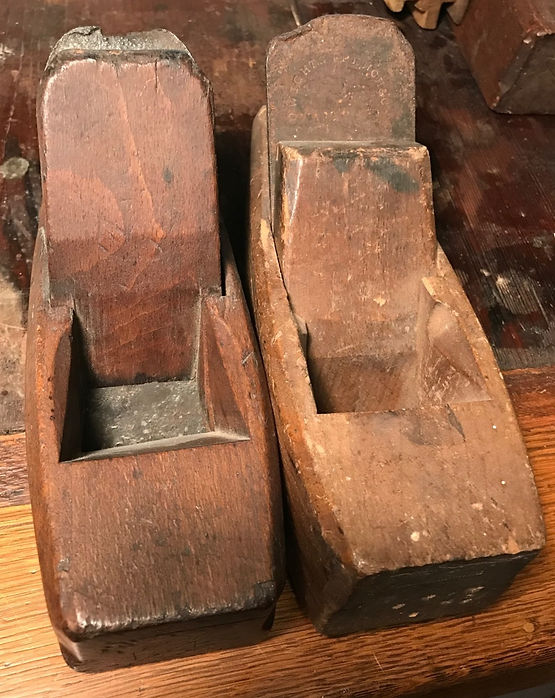
Based on Thomas Elliott's article (The Chronicle 74-1, 6-2021), "John & Moses Sleeper", and GAWP5, I Sleeper's planes exhibit two imprint wear states, flat vs small round body chamfers and wedge outlines B, A1, A2 that together translate into early, classic and late plane styles. In GAWP5 and The Chronicle article: wedge B is early, wedge A1 is classic and wedge A2 is late. Early and classic planes have flat chamfers while late planes have small round chamfers. Early and late examples are rare and details are not known for any early or late planes with a bench-escapement. The "classic" imprint bench-escapement planes have an abutment cheek chamfer style that can be described as a small ellipse that ends about 1/2" short of the wedge contact point (chamfers width of 1/8"). (Toted examples above and smoothers below). One smoother with a double iron and a double ironed toted sash have cheek chamfers that are a somewhat larger ellipse (chamfers width of 1/4"). It is not known if these larger ellipse examples can be considered a later form "classic" plane or whether they are random variations.


A Smith. Aaron Smith, 1769 Swansea, MA - 1822 Rehoboth, MA.
Left, large A1 A Smith / Rehoboth imprint. 1/4" flat body chamfers. It was made for a single iron. The wedge abutment cheek chamfers are eliptic and narrow / moderate in width. They do not meet the wedge contact. The middle smoother is also the large A1 imprint. It currently is fitted for a double iron. It has heavy round chamfers on top of the body and flat on the ends. The wedge abutment cheek chamfers are still eliptic, but are wider with a tear drop shape starting to form.They do not meet the wedge contact. The smoother on the right has the smaller A Smith / Rehoboth B imprint. It was made for a double iron. It has heavy round chamfers on top of the body and flat on the ends. The wedge abutment cheek chamfers are eliptic with the start of a tear drop shape. They do not meet the wedge contact. All have body chamfers that end with simple turn outs.

Rear, large A1 A Smith / Rehoboth imprint. Jointer with 1/4" flat body chamfers, single iron, offset tote. The wedge abutment cheek chamfers are eliptic and narrow / moderate in width. They do not meet the wedge contact. Foreground, jointer with the smaller A Smith / Rehoboth B imprint. Single iron and offset tote. It has heavy round chamfers on top of the body and flat on the ends. The wedge abutment cheek chamfers are a partial tear drop shape. They do not meet the wedge contact.

N Taber. Nicholas Taber, Fairhaven, MA, 1761 to 1849.
Upper, an earlier N Taber crown molder with flat chamfers and wedge abutment cheek chamfers that are flat, straight and narrow. Lower, a later N Taber crown molder with heavy round body chamfers. The wedge abutment chamfers are eliptic and do not meet the wedge contact.

Jn Tower. Jonathan Tower 1758 Sudbury, MA - 1846 Rutland, MA.
Jn Tower 13 3/8" panel with 1/4" flat chamfers that end with a step and small turn-out. The wedge abutment cheek chamfers are somewhat different than the other MA craftsmen with a flat parallel section towards the toe that tapers and ends prior to the wedge contact.
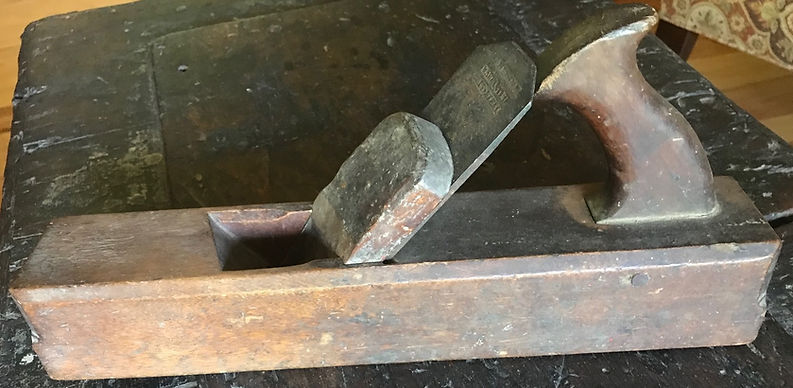

I Walton and I Gould. John Walton Jr. (master) 1710 - 1785 Reading, MA. Joseph Gould (apprentice), 1730 Stoneham, MA - 1810 Reading, MA.
Upper foreground, I Gould / IG marked crown molder with 5/16" flat chamfers and flutes (an early example of his work). The wedge abutment cheek chamfers are flat, parallel and very narrow (1/16"). Upper background, I Walton / In Reading crown molder with 3/8" flat chamfers that end with long tapers (no flutes). As with the above I Gould example, the wedge abutment cheek chamfers are flat, parallel and very narrow. In this example they're less than 1/16". Below are closeups of the I Gould / IG (right) and the I Walton / In Reading (left).


I Walton / In Reading compassed smoother with 1/4" flat chamfers that end with a step and a short turn-out. This chamfer stop is found on late examples of his work, not unlike those found on the planes made by his sons John III and Benjamin. The wedge abutment cheek chamfers are narrow and tapered, ending at the wedge contact point.

H Wetherel. Henry Wetherel Jr., Norton, MA and Chatham, CT, 1729 to 1797.
Upper, an earlier H Wetherel / In Norton panel plane (pre 1780). 1/4" flat chamfers with flutes. The wedge abutment cheek chamfers are flat and tapered with a "medium" width. Lower, a later H Wetherel / Chatham jointer (post 1779) with 1/4" flat chamfers which end with a simple turnout ... no flutes. The wedge abutment chamfers are flat and tapered, matching those of the above "H Wetherel / In Norton" jointer.

