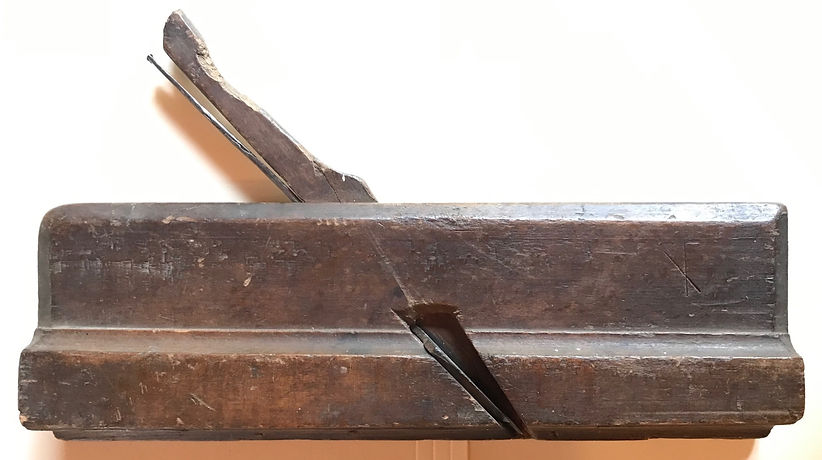
C Doll
Likely candidate:
-
Conrad Doll of Lancaster, PA, cabinetmaker (1772 - 1819)
His uncle Conrad Doll of Fredrick Town, MD, cabinetmaker, (b 1739) is too early

C Doll
Likely candidate:
Conrad Doll
Lancaster, PA, cabinetmaker
(1772-1819)
parents; Johannes and Elizabeth
m Maria Trissler 1801
ch Elizabeth
m Mary Graff 1804
ch Catherine and Mary Anne
Information on Conrad's uncles Joseph and Conrad, follows at the end.
Three Conrad Doll's are found in PA tax records and US census from 1800. The two York Conrad's (Sr. and Jr.) were farmers.
Information on Conrad Doll by Jeff Moore:
Excerpts from; Genealogy and Story of Conrad Doll (1772-1819); Organ Maker & Schoolmaster of Lancaster, Pennsylvania (2011).
“Conrad Doll was a talented man, tunebook writer, cabinet maker, organ maker, and later, schoolmaster. He resided in Lancaster, Pennsylvania in the early 1800s. He experienced much personal loss, and his life ended in disgrace.” 6
Tunebook
"The Doll book...restricts itself exclusively to songs of a religious nature. The sources from which Conrad Doll drew the hymns for his Sammlung [include] Zollikofer, Bachofen, and Schmidlin...the most ingenious and inventive of these Swiss hymn writers." (p. 235, 236)"
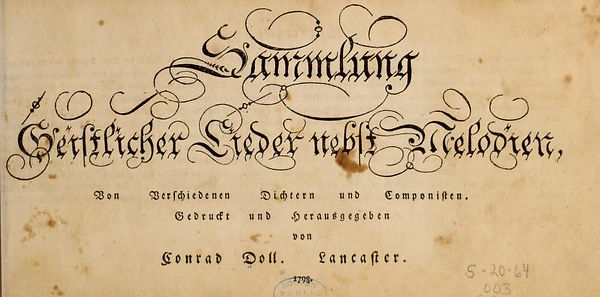
"Sammlung Geistliche Lieder nebst Melodien," printed and published by Conrad Doll, Lancaster, Pa., 1798, 112 p. 12
Two Organs
“Conrad Doll is best known for the organ which he built in 1807 for Peace Church, near Camp Hill, Cumberland County, Pennsylvania. Pictures of it can be seen by googling "Doll Organ at Peace Church".”
Noack wrote: "On July 6, 1807, "Conrad Doll of Lancaster, organ maker ... " and two Elders of the German Reformed and Lutheran Congregations signed an agreement regarding an organ "with six complete stops or sets of pipes." The price was $466.67 in federal money, plus shipping and travel expenses."
"Doll's workmanship on the Peace Church organ shows him to be a very capable cabinet maker as evidenced in the well-made, elegant case, competently made wind chest, wooden pipes, and other wooden parts. His metal pipes show considerably less competence"15,16
“Note: Chamber Organ
Raymond J. Brunner describes a second organ which came to light at a 1978 estate sale:”
"The organ is a two stop chamber organ in a small Hepplewhite style case. It was probably built between 1805 and 1810...The size of the organ and case style suggests that it was built for household use rather than as a church organ."
"The chamber organ measures 4 feet wide by 2 feet deep and is 3 1/2 feet high. Its Hepplewhite case is African mahogany with inlay banding of curly maple and walnut. The top of the case is solid mahogany, while the curved doors and the sides are mahogany veneer over pine. The 54 note keyboard has ivory natural coverings with poplar sharps, stained black. At each end of the keyboard is an inlaid cheek block and beyond the cheek blocks are pierced wood grilles for sound emission." 17
6. Moore, Jeff, Genealogy and Story of Conrad Doll (1772-1819); Organ Maker & Schoolmaster of Lancaster, Pennsylvania (2011). Moore-J--Conrad-Doll-Story.pdf
12. Stapleton, Rev. A., "Researches in the First Century of German Printing in America - (1728-1830.)", The Pennsylvania-German Vol. 5 (April 1904) No. 2, p. 81. p. 83. (viewed on Google books)
15. Noack, Fritz, "The Doll Organ at Peace Church", The Tracker : Journal of the Organ Historical Society, Inc. Vol. 20, Nbr. 1, Fall 1975, p. 7. (viewed at URL https://organhistoricalsociety.org/downloads/tracker/public/…).
16. Cooper, Philip T. D., "The Followers of Tannenberg (chapter 5)," in David Tannenberg: Master Organ-Builder from Early Pennsylvania. (n.p.: URL www.davidtannenberg.com/Chapter5.htm & photos at davidtannenberg.com/Peace_Church
17. Brunner, Raymond J., "A Conrad Doll Chamber Organ", The Tracker : Journal of the Organ Historical Society, Inc. Vol. 25, Nbr. 2, Winter 1981, p. 16. URL organhistoricalsociety.org/downloads/tracker/public/old/1981-25-2.pdf. Brunner--Conrad-Doll-Chamber-Organ.pdf
1807 organ notes from History of St. John's Evangelical Lutheran Church by Rev. Claude Dierolf.

1798 songbook by Conrad Doll, images courtesy Internet Archives.

1805 Lancaster deed for Conrad Doll, joiner and cabinetmaker.

1807 organ by Conrad Doll, image courtesy of Peace Church in Cumberland, PA.

Conrad's Uncles
Joseph (carpenter) and Conrad (cabinetmaker), were raised in Lancaster, PA. They moved to Frederick Town, MD in ca 1765 and 1761, respectively. Joseph left a ledger dating to 1761-1789. The ledger is presented in Chipstone Foundation's publication; Crossroads of Cultures; 18C Furniture from Western MD by Sumpter Priddy III and Joan K. Quinn.
Here's Joseph Doll's ledger information from the Crossroad of Cultures article by Priddy and Quinn:
"Joseph Doll’s ledger (written in phonetic English) indicates that he provided a wide range of products and services for his Germanic and British neighbors between 1761 and 1789. The largest portion of his business involved the production of an astonishing variety of building materials, including sills, joists, flooring, studs, lath, rafters, and shingles. Except for an occasional door or window sash, Joseph Doll was not involved with finish carpentry or interior woodwork. Similarly, furniture making was only a small part of his business. His ledger indicates that he constructed less than twenty pieces between 1773 and 1777 and a few scattered examples in the following years.[21]
Doll produced more bedsteads than any other form: Six had low posts, one had high posts, and two were cradles. The low-post bedsteads ranged in price from eleven shillings to twelve shillings eight pence. Four were made in pairs, one of which was “Painted Green.” The “bedStid with high Posts painted blue with four Scroos” was the only example assembled with bed bolts. Made in 1787, it cost £2.7.6—over twice as much as any bedstead from the prior decade. The second most expensive bedstead was purchased by Christian Weaver. In 1774, he paid £1 for a “Greadle to Rog his Chylde.” The other cradle, made the following year, cost John Brunner 18 shillings.[22]
Doll’s ledger also records the production of seven tables that ranged in price from £1 to £1.8. Although two of the tables were not described, two were “walnut,” one had “2 Drawers and brass hands,” one was referred to as a “Kitchin Table,” and one was described as a “Larch Pobler Table for a workebench with Two Trawers in it with divicions.” John Hoober, a glass engraver at Amelung’s New Bremen Glassmanufactory, paid Doll £1.7 for the latter in 1775. [23]
Doll produced only four case pieces, but they were the most expensive furniture forms recorded in his ledger. John Brunner paid £3.15 for a “Kitchin Cobert” in 1775; Casper Mantz paid £3.5 for a “Chest with drawers” for his “Daughter Caety” in 1775; Peeter Brunner paid £7 for a “Kitchen Dresser with glas and furniture” in 1776; and John Kyle paid £4.10 for a “Corner Cobbert” in 1789. The dresser Doll made for his neighbor Brunner was twice as expensive as any piece he had made prior to that time, and over two and a half pounds more than any recorded later in his career.[24]
Like many other woodworkers, Doll made coffins. Between 1775 and 1789 he made seven at prices ranging from five shillings to £1.15. He also repaired furniture and made a variety of kitchen goods, including a door for a fireplace, a cutting box, and a bread tray with a lead liner. His ledger indicates that he mended several chairs and made Henry Cronier “a Sidepeese to his bedStid paint blue.” Regrettably, none of the surviving household furnishings from western Maryland can be associated with Doll’s ledger entries.[25]
[21] Joseph Doll Ledger, 1772–1805, Historical Society of Frederick County, Inc., Frederick, Maryland.
[22] Joseph Doll’s ledger contains the following entries for bedsteads: Henry Shover, October 1773, “one pair of bedSteds Painted Green... £1.5”; Francis Mantz, January 10, 1775, “one bedstid . . . 12s”; John Brunner, Jr., July 8, 1775, “one pair of bedStids at 3 dollars . . . £1.2”; John Hummel, March 29, 1777, “one Little bedStid . . . 12s”; Michael Christ, February 1787, “one bedStid with high Posts painted blue with four Scroos . . . £2.7.6. ”Doll’s ledger contains the following entries for cradles: Christian Weaver, November 26, 1774, “one Greadle to Rog his Chylde . . . £1”; John Brunner, Jr., July 8, 1775, “a Creadle . . . 18s.”
[23] Joseph Doll’s ledger contains the following entries for tables: Francis Mantz, September 1773, “one Walnut Table with Two Drawers . . . £1.5”; John Brunner, Jr., July 8, 1775, “making a Table at 20 . . . £1”; Caspar Mantz, September 26, 1775, “one Table for his Daughter Caety . . . £1.2.6”; Jacob Stealey, October 11, 1775, “one Table with 2 Drawers and brass hands . . . £1.7.6”; Peeter Brunner, March 18, 1777, “one Walnut Table at Three dollars . . . £1.2.6”; Mathias Zimmer, February 10, 1786, “one Kitchin Table . . . £1.5.0”; John Hoober, February 2, 1775, “one Larch Pobler Table for a workebench with Two Trawers in it with divicions . . . £1.7.”
[24] Joseph Doll’s ledger contains the following entries for case furniture: John Brunner, Jr., February 6, 1775, “one Kitchin Cobert . . . 3.15”; Caspar Mantz, September 26, 1775, “one Chest with drawers for ditto [daughter Caety] . . . £3.5”; Peeter Brunner, February 16, 1776, “one Kitchen Dresser with glas and furniture . . . £ 7”; John Kyle, March 7, 1789, “one Corner Cobbert . . . £4.10.”
[25] Joseph Doll’s ledger contains the following entries for coffins: John Breidenbach, May 15, 1775, “To one Coffin . . . 10s”; Peeter Brunner, December 8, 1775, “To one Coffin . . . 10s”; Peeter Brunner, February 16, 1776, “To one Coffin for his Son John at 25/ . . . £1.5”; Christian Weaver, November 26, 1776, “One Smol Coffin for his Childe . . . 5s”; Peeter Brunner, March 18, 1777, “To one Coffin for his Father . . . 1.15”; John Brunner, Jr., undated, “one Coffin for his Father . . . £1.10”; Phillip Friegi, January 14, 1788, “One Coffin for M [illegible] Wittman . . . £1.5.” In 1774, Doll charged Thomas Preise 1s 6d for “mending Two Chairs.” On June 16, 1790, Doll charged Henry Cronier 2s 9d for “Making a Sidepeese to his bedStid paint blue.”
10 1/4" long beech C Doll molder.