
W Allen (small mark)
1st tier candidate
-
Walter Allen, b 12-1-1759 in Sandwich, MA, working in New Bedford, Mendon and Springfield, MA, d 6-23-1845 in Smithfield, RI, housewright and carpenter
2nd tier candidates
-
William Allen, 1799, Sturbridge, MA, house carpenter
-
William Allen, 1803, West Springfield, MA, joiner
-
William Allen, 1808, Bath, ME, housewright
-
William Allen, 1806, 1807, Frankfort, ME, house joiner and carpenter
-
Willard Allen, 1793, 1798, 1799, 1803, 1810, 1812, 1813, 1817, Sturbridge, MA, housewright and carpenter, wife Hepsibah
Plane photographs courtesy of Mike Humphrey

W Allen (small mark)
1st tier candidate:
-
Walter Allen, b 12-1-1759 in Sandwich, MA, d 6-23-1845 in Smithfield, RI
parents John and Elizabeth
apprenticed to Matthew Howland, carpenter, at New Bedford
1778 RW Capt E Lewis
to Mendon, MA 1780
1784 deed, Mendon, MA, housewright
1784 m Mehitable Kelly 1784, Quaker
to Union Village / Smithfield, RI 1784
1795, 1797, 1806 deeds, Smithfield, RI, housewright and carpenter
m Lucy Buffum 1800
m Mary Barker 1813
2nd tier candidates
-
William Allen, 1799, Sturbridge, MA, house carpenter
-
William Allen, 1803, West Springfield, MA, joiner
-
William Allen, 1808, Bath, ME, housewright
-
William Allen, 1806, 1807, Frankfort, ME, house joiner and carpenter
-
Willard Allen, 1793, 1798, 1799, 1803, 1810, 1812, 1813, 1817, Sturbridge, MA, housewright and carpenter, wife Hepsibah
Fitting Walter Allen into the Craftsmen's World of SE MA and RI ca 1780's
by Michael Humphrey
Walter Allen, like so many of our known early planemakers, was a fine and prolific builder. If he was the maker of the few [small imprint] W. Allen planes which still survive [and that seems likely], then he probably made them early in his working career.
Walter was in Smithfield, RI from 1784 onward, and in Mendon, MA from 1780 to 1784. He entered the Continental Army in 1778, so he could have been working in an unknown location for a short period between the war and Mendon. Prior to his war service, Allen apprenticed in New Bedford, MA. W Allen planes are rare, but neatly made, displaying an array of style features used by other known planemakers from Southeastern MA and Rhode Island during the 1770’s and 1780s. One sash plane [GAWP 5] has an ogee molded shoulder, and a separate hollow plane has a cove molded shoulder, so he made planes over some period of time. While his style features are specific to a certain region and period, they point to no other, single maker as the inspiration. On the hollow plane, Allen used chamfer stops with strongly tipped steps and bold, chiseled turn outs, very much like those on late Chelor planes. The molded shoulder on Allen’s sash plane also points to Chelor [or to John Nicholson], but Allen’s closed tote looks most like a Jo Fuller [three dot], or a Charles Dupee, or R Dyer; not just like a Chelor. The finial on the hollow plane wedge is oval with a moderate relief, not flat backed like many late Chelor planes.
E Taft and S Partridge, the two known Mendon planemakers, used chamfers stops somewhat similar to Allen’s on the hollow plane, but less tipped, and more delicate. In addition, an existing E Taft closed tote is similar to Allen’s, but only similar. Both Taft and Partridge used flat backed finials, unlike Allen.
Interestingly, Allen put long, shallow flutes onto the corners of the hollow below the chamfer stops. That feature is rare, but is seen on I Iones [Holliston] planes, and on planes made by H Healy and R Marsh.
For certain, we know that Walter Allen built fine homes in Smithfield, RI around the turn of the 19th century, and it is likely also true that he made planes in Smithfield, MA or in Mendon, MA, probably in the 1780’s.
Walter Allen and family information from "One Hundred and Sixty Families" by John Osborn Austin, Providence, RI, 1893


Walter Allen, 1784 deed, Mendon, housewright

Walter Allen, master builder in Union Village / No. Smithfield, RI
NATIONAL REGISTER OF HISTORIC PLACES INVENTORY-- NOMINATION FORM
National Park Service, Union Village Historic District, North Smithfield
"Walter Allen, a local master builder, was responsible for several of the largest buildings including the tavern operated by Seth Allen. The rusticated doorways which he designed for his own home at 138 Great Road are also seen on two other houses at 71 and 76 Great Road. Five of these Federal houses are distinguished by their unusual pedimented porches with vaulted ceilings. They are evidently the work of one builder-designer (probably Walter Allen, as he is known to have built 137 and 138 Great Road) for in most instances they repeat the same detail; the house wall is rusticated just under the porch section. (1) Antoinette F. Downing, Early Homes of Rhode Island (Richmond Garrett & Massie, l937), p. 345."
Walter Allen 1802 house in No. Smithfield (Union Village)

"138 Great Road
Walter Allen House . 1802. Walter Allen, builder. Federal ; 2½ storeys; flank-gable roof; 5-bay façade, center entrance with semi-circular fanlight surrounded with rustication under a pedimented portico which has fluted pilasters and Tuscan columns, splayed lintels over windows, Colonial Revival alterations on rear elevation include a verandah, a 2-storey bay window, a Palladian window on second storey; 2-storey ell on the western end.
Built by Union Village’s early nineteenth- century master builder, the Alien House is the earliest structure within the Village associated with Allen and demonstrates characteristics associated with his work, such as the rusticated wall surface under the portico. The Allen House was the site of the first Roman Catholic services in the area, held in 1829, and it later functioned as a tavern. The Colonial Revival alterations were effected by Edgar H. Slocomb early in the twentieth century."
NATIONAL REGISTER OF HISTORIC PLACES INVENTORY-- NOMINATION FORM
National Park Service, Union Village Historic District, North Smithfield
Stephen Brownel 1806 house in No. Smithfield (Union Village), built by Walter Allen

"86 Great Road
Stephen Brownell House. 1806. Walter Allen, builder. . . Federal; 2 storeys, L-plan; hip roof; 5-bay facade, center entrance with enclosed hip-roof 1- storey portico.
The Brownell-House was built in two sections, and the rear portion is probably the older part. The use of a hip roof is unusual in Union Village, where the flank-gable roof was standard, and the only other' example is the monitor-on-hip roof on the Gray Homestead. The large, Late Victorian barn, with massive- timber framing and a cupola, at the rear of the house, once served as a school for the village."
NATIONAL REGISTER OF HISTORIC PLACES INVENTORY-- NOMINATION FORM
National Park Service, Union Village Historic District, North Smithfield
Seth Allen Tavern 1804, in No. Smithfield (Union Village), built by Walter Allen

120 Great Road
Seth Allen Tavern. ca 1804. Walter Allen, builder. Federal; 2½ storeys; flank-gable roof; 5-bay facade, center entrance with transom light under balustraded portico, balustraded terrace across facade sits on a high rusticated and arcaded basement. The Seth Allen Tavern, one of the major Union Village stagecoach stops, was built as an inn on the well-traveled road between Providence and Worcester. It remained in one of as an inn on the lively competition with the George Aldrich Inn across the street through-out the stagecoach era and served such notables as the Marquis de Lafayette during his 1825 visit to this country. In spite of the village’s decline as a transportation center (brought on by the growth of the railroads, the building remained in use as a tavern until converted into a private residence in the early twentieth century.
NATIONAL REGISTER OF HISTORIC PLACES INVENTORY-- NOMINATION FORM
National Park Service, Union Village Historic District, North Smithfield
W Allen (small mark) 10 3/16" long, birch molder. Photos courtesy Mike Humphrey.


W Allen (small mark) 29 1/2" long, birch jointer. (Tote might be maple or cherry.) Photos courtesy Mike Humphrey.


The W Allen Tote Design
18th C New England jointer totes are individualistic and tend to share design elements which are regional, reflecting craftsmen interactions and associations. The is especially true with the planes made by 18th C masters and apprentices. (See related articles on H Wetherel and E Clark of Norton and Middleboro respectively.) Below are jointer plane totes of Charles Dupee, R Dyer and (3 dot) Jo Fuller which share strong, common tote design elements seen in the W Allen (small mark) jointer above. Based on the totes, it is reasonable to suggest that these craftsmen trained and worked in a common region within a common period of time. (Walter Allen (small mark), in Mendon, MA and No. Springfield, RI ca 1780s - 1790s, Charles Dupee Sr. (small mark) in Wrentham, MA ca 1765-1782, Rufus Dyer in Bridgewater, MA ca 1790-1795 (later Union, ME) and Joseph Fuller (3 dot / In Providence mark), in Providence, RI ca 1770s-1780s.)
W Allen small mark jointer tote shown above, Mendon, MA, working dates ca 1780 - 1784 and No. Smithfield working dates post 1784.

Charles Dupee Sr. small mark jointer plane tote, Wrentham, MA, working dates of 1765 - 1782.
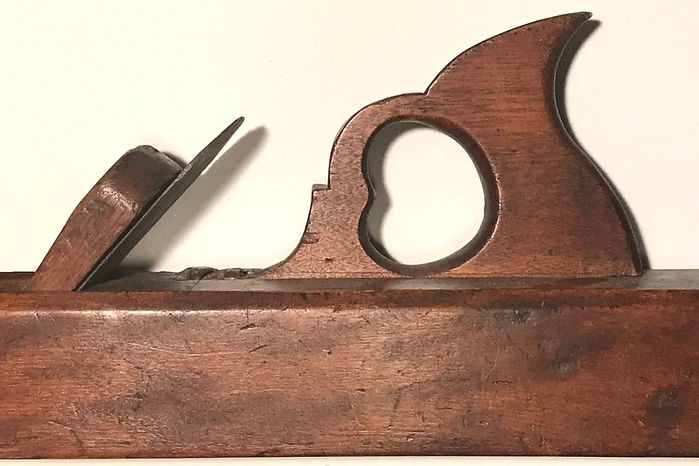
R Dyer jointer plane tote, working dates ca 1790 - 1795 in Bridgewater, MA (later Union, ME). This is the Rufus Dyer identity presented in this website's New Information Section. (The Rufus Dyer presented in GAWP5 worked in Providence, RI, in the 1790s.) This jointer has heavy round chamfers on the body top which fits with the later 1790 - 1795 date.

Jo Fuller (rare 3 dot / In Providence imprint) joiner plane tote, Providence, RI. The working dates associated with this imprint are believed to be the 1770s and 1780s.
