L Ferry
One 1st Tier Candidate
-
Luther Ferry
-
b 11-15-1773 d 2-15-1863, Granby, MA
-
1799, 1804, 1807 deeds, Granby, cabinet-maker
-
1828, 1830 paid for coffins
-
1855 census, mechanic and farmer

L Ferry
1st tier candidate:
Luther Ferry
b 11-15-1773 d 2-15-1863, Granby, MA
parents Charles and Mary
m Azuba Dickenson 1797, they had 10 children in Granby, including Capt. Lucius b 1800 joiner and Luther b 1804 farmer.
1799, 1804, 1807 deeds, Granby, MA, cabinet-maker and shop joiner
1810 1st year he was elected selectman in Granby
1828 and 1830 paid for making coffins
1855 census, mechanic and farmer
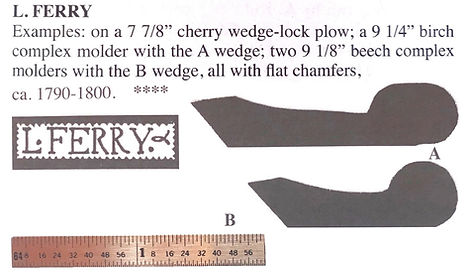
Luther was the only candidate found using FamilySearch's Full-Text search tool. Note that the A wedge points to SE MA area. (It is possible that L Ferry did not make the plane with the A wedge.)
Plane photographs courtesy of Mike Humphrey.
L Ferry / S Howland
by Mike Humphrey June 12, 2026
Recent research has revealed that Luther Ferry was the likely maker of known wooden planes marked L Ferry [see New Information]. Luther [1773-1863] lived in Granby Ma., south of Amherst Ma., and was listed as a cabinetmaker in Granby deeds dated 1799, 1804 and 1807.
It has been noted that there are strong similarities between a plow plane made by L Ferry, and one made by S Howland.
Southworth Howland was born in Barnstable Ma. [Cape Cod] in 1775 and presumably lived in Conway Ma. in 1799 [his son, the Amherst Ma. planemaker was born there in 1799 – GAWP 5]. For some period prior to 1846, Southworth was a house carpenter in West Brookfield Ma. where he is known to have worked on a house designed by Asher Benjamin [GAWP 5]. Conway Ma. Is about 5 towns northwest of Granby, and West Brookfield is 3 towns straight east of Granby. When or where Ferry and Howland were in close proximity is not known [if they were at all], but at the very least, their planes closely share regional style features from the same period.
Two planes each by Howland and Ferry were available for study. All have flat chamfers high on the corners [5/16” wide for both plow planes]. Unfortunately, both original Ferry wedges are gone, but the Howland wedges are correct. The L Ferry “A” wedge in GAWP 5 is, I assume, not by Ferry, but the “B” wedge could be accurate. An L Ferry boxed ogee, 9 3/16” long, has flat chamfers which turn out. All three of the other planes are either maple or cherry. A 9 ½” long S Howland round plane is of cherry, with flat chamfers that turn out. That plane has its escapement on the left side.
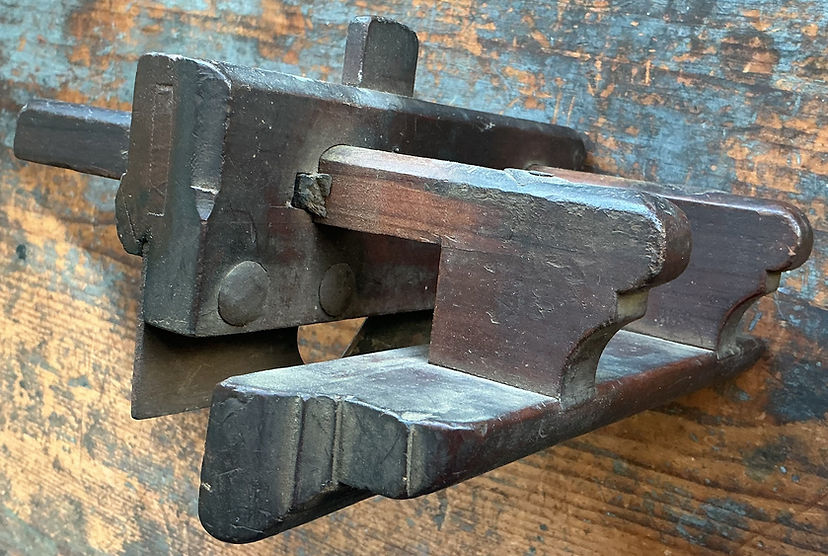
The S Howland plow is probably made of maple [it is uncleaned], but possibly of cherry. It is 8 3/8” long with flat chamfer that turn out. The L Ferry plow appears to be of cherry, but could be of maple [that plane is also uncleaned]. It is 7 15/16” long, and has flat chamfers which step and turn out. The Ferry name is imprinted on both ends. Because the name is stamped on both ends [unprofessional], and because of the step and turn out stops, the L Ferry plow could be the earliest of the four planes. (The Ferry plow’s inset arms are also an early feature.) Both plows are wedge locked, with the wedges on the outsides of the arms. Beyond the similar chamfers, the short lengths of 3 of the 4 planes, the atypical woods and the wedge lock plow designs, the most strikingly similar features shared by the Ferry and Howland planes are the plow fence arms. Both have round topped arms with supports of the same outline.
Given the considerable rarity of both makers, it is unlikely that either copied the other after seeing numerous planes in common use by other tradesmen. Instead, it is probable that the two men worked in close proximity early in their careers.
Luther Ferry, 1799 deed, Granby, MA, cabinet-maker.

L Ferry beech, ogee molder, 9 3/16" long, courtesy Mike Humphrey.

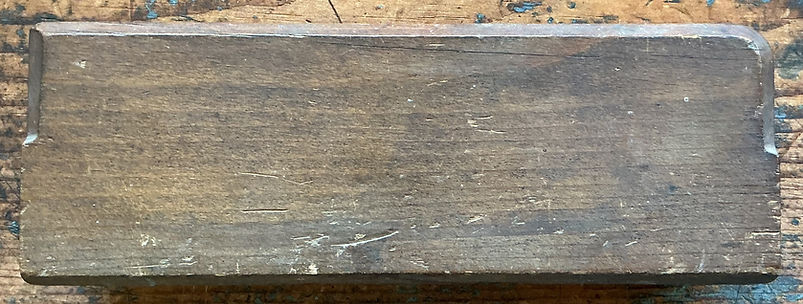
L Ferry beech, cherry plow, 7 15/16" long, courtesy Mike Humphrey.