
A Adams
One 1st Tier Candidate for the large mark
-
Andrew Adams, housewright
-
b 5-29-1715 Ipswich, MA – to Grafton 1740/50 - d 9-23-1782 Grafton, MA
One 1st Tier Candidate for the small mark
-
Amos Adams, carpenter and housewright
-
b 1776 Medfield, MA – to Boston, MA by 1798 - to Salem, MA ca 1803 – d Portland, ME 1849
One 2nd Tier Candidate for the large mark
-
Archelaus Adams, joiner and shipwright
-
b 1714 Newbury, MA – d 1783 Salisbury, MA

A Adams
Candidate Summary
(These candidates are presented as alternates to the GAWP5 candidate Amos Adams (1762 - 1786).)
One 1st Tier Candidate for the earlier Large Mark
(Andrew's working dates likely preclude him from making the later small mark planes.)
-
Andrew Adams, housewright
-
b 5-29-1715 Ipswich, MA – to Grafton 1740/50 - d 9-23-1782 Grafton, MA
-
deeds 1739, 1746, 1747, 1748, 1750, 1754, 1755, 1759 housewright
-
deeds 1761, 1764, 1765, 1766, 1770 yeo
-
1770s deeds, not sure of this being the father or the son, trade is a yeoman
-
m Elizabeth Hunt 10-15-1741
-
m Sarah Thwing 5-30-1771
-
1782 probate with inventory; “carpenters & joiners tools … 3 pounds”
-
While being somewhat early for the large mark smoother, Andrew does fit within the plane's SE MA features / details and estimated date range of mid 18th C / 3rd Q 18th C. (The estimated date range for the plane is that of the editor's.)
-
Andrew's son Andrew Adams Jr., b 1751 Grafton, MA – d 1841 Grafton, MA is not considered a candidate as there are no references to him as a craftsman. With the1770s deeds, we're not sure of whether these deeds refer to the father or the son, but in either case the trade is given as a yeoman. In the 1793 and 1794 deeds, he's a yeoman. He was in the RW in corporal Drury’s Co. and m Lucy Merriam 6-7-1775. His son, Andrew (3rd), died before he did as was mentioned in his1841 will. No inventory was located.
One 1st Tier Candidate for the later Small Mark
(Amos's working dates preclude him from making the earlier large mark smoothing plane.)
-
Amos Adams, carpenter and housewright
-
b 1776 Medfield, MA – to Boston, MA by 1798 - to Salem, MA ca 1803 – to Portland, ME after 1810 - d Portland, ME 1849
-
His parents were Elijah and Abigail, living in Medfield, MA
-
1798 Boston, Newbury St., Ward 11, tax list, carpenter
-
1798 Boston, probate bond, housewright
-
1803, 1806, 1809, 1810 deeds, Salem, MA, housewright, house joiner
-
1823 Portland, ME, housewright
-
1849 Portland, ME death record, joiner
-
m Margaret Flint 1805 in Salem
-
m Mary LaFavour 1809 in Salem then to Portland, ME where 9 children were born
-
Amos being born and raised in Medfield, MA and then working in Boston by 1798, fit within the SE New England location and the 1780's - 1790's date estimate for the small mark planes. Note that Amos's parents stayed in Medfield. (The small mark plane's 1780's - 1790's date estimate is that of the editor's.)
-
Amos's son Amos Jr, b 1805 – 1810 -, was a joiner in 1837 / 8 Portland, ME. He is too late to have made the small mark planes.
One 2nd Tier Candidate for the large mark
-
Archelaus Adams, joiner and shipwright (considered 2nd tier because of Salisbury's distance from SE New England.)
-
b 1714 Newbury, MA – d 1783 Salisbury, MA
-
1745, 1747 deeds Salisbury, MA, joyner
-
1758, 1759 deeds Salisbury, MA, joiner
-
1764 deed Salisbury, MA, joiner
-
1771, 1774 deeds Salisbury, MA, shipwright
Others
-
Archelaus's son Archelaus Adams (Jr), b 1755 – d 1828 Salisbury, MA, farmer, is not considered a candidate as there's no reference to him as a craftsman.
-
Artemas Adams (he is too late for the small mark A Adams planes).
-
b 1800 - d 1829 Walpole, NH, joiner
-
1823 repair meeting house roof
* FamilySearch's Full-Text tool used to search MA, CT, RI, VT, NH and ME period records.
Details for Candidate Andrew Adams (1715 - 1782)
Andrew Adams, 1749 deed # 30-177, Grafton, MA, housewright.

Andrew Adams, inventory 1782, Grafton, MA.


Details for Candidate Amos Adams (1776 - 1849)
Amos Adams, Boston tax list, 1798, Newbury Street, carpenter.

Amos Adams, signer on a Boston probate document, 1798, housewright.

A Adams
Assessing the Marks and the Planes
With two "similar" and / or "possibly related" imprints on 18th C planes separated by roughly a generation, it is reasonable to assume that the planes were either;
1) made over the lifetime of a single craftsman - or -
2) made by two generations of a given family.
This is especially true if the planes appear to have been made in a common geographical area ... such as in this case, SE New England.
None-the-less, one needs to ask an important question (as posed above); do the planes look like they were made by a single craftsman or by two generations of a common family living within a limited geographical area? With planes made over the course of a generation in the mid to late 1700s, the chamfers, chamfer stops, heel radius and wedge shapes will show a transformation in style over time. That's to be expected. (See Ce Chelor, H Wetherel, Jo Fuller.) The "subtle" construction details, such as imprint placement, layout lines vs no layout lines, wedge finishing details, etc, however, should remain relatively consistent for the planes, unless they were made by different craftsmen. (Please note that an assumption is being made ... that the planes of each "given" imprint are consistent with respect to their own "subtle" construction details.)
Two planes are used in this assessment of A Adams planes, a birch smoothing plane with the large mark (the only plane that's known with this imprint) and a birch smoothing plane with the small mark. Both planes remain in relatively untouched condition. (A small mark fruitwood jointer is used in support as applicable.) It should be stated that studying a limited number of planes is not the best scenario, but only one large mark plane has been reported. Hopefully additional large mark A Adams planes will be found.
The early, pre RW A Adams large mark smoother has a double stamped imprint with a vertical alignment on toe (upper) vs the ca 1790s A Adams small mark smoother with a single stamped horizontal imprint on the toe (middle). A small mark jointer has the same imprint placement as does the small mark smoother (lower).
Also of note, the differences in the upper toe to side angles observed in the smoothers. The large mark smoother has the upper toe at 90 degrees to each side. In contrast, the small mark smoother and the small mark jointer, have their upper toes forming an upward angle left to right. While grain-based warping of bench plane bodies does occur, these pronounced "angled" toes are not typically seen. (From a grain / warp perspective, the small mark smoothing plane's grain runs counter to the toe's angle while the small mark jointer plane's grain supports the toe's angle. The large mark smoother's grain direction matches that of the jointer.)


The early, pre RW A Adams large mark smoother (above) and the ca 1790s A Adams small mark smoother (below). The large mark smoother has faint layout lines for the escapement (both sides of the body) while the small mark smoother does not. (A small mark jointer does not have layout lines.)

The early, pre RW A Adams large mark smoother (above) and the ca 1790s A Adams small mark smoother (below). The large mark smoother has a wedge with a somewhat tombstone shape with the angled break separating the upper wedge face from the lower wedge face lying just above the wedge abutment contact points. The small mark smoother has a more rounded shape while the angled break separating the upper wedge face from the lower wedge face is significantly higher than the wedge abutment contact points. (Other than being slightly wider, the small mark jointer has a wedge that matches the small mark smoother wedge.)
The small mark smoother and jointer have 2" long escapement lengths while the large mark smoother has a 1 3/4" long escapement length. (Here, the escapement lengths themselves are not necessarily significant, just the pattern of difference seen between these large and small mark planes.)

The early, pre RW A Adams large mark smoother (right) and the ca 1790s A Adams small mark smoother (left). The chamfer stop details fit with the relative ages of the two planes; fluted stops on the earlier large mark plane (ca 1750 - 1770) and the step with a turnout stops on the small mark plane (ca 1780 - 1790). (The small mark jointer has chamfer stops matching the small mark smoother.)

The early, pre RW A Adams large mark smoother (above) and the ca 1790s A Adams small mark smoother (below). The wedge abutment cheek chamfers fit with the relative ages of the two planes; parallel flat chamfers on the earlier large mark plane and the flat but tapered chamfers on the small mark plane. (The small mark jointer has wedge abutment cheek chamfers matching the small mark smoother.) In addition, the older plane's footprint is shorter and less tapered in width at the toe and heel than the later plane. (The large mark smoother is 7 1/4" by 2 3/8" and the small mark smoother is 8" by 2 5/8". As a comparison, an F Nicholson smoother is 6 7/8" by 2 3/8" with footprint heel and toe tapers that match the large mark A Adams smoother.) These design elements are consistent with the relative construction dates of ca 1750 - 1770 vs ca 1780 - 1790 and a common SE New England location.
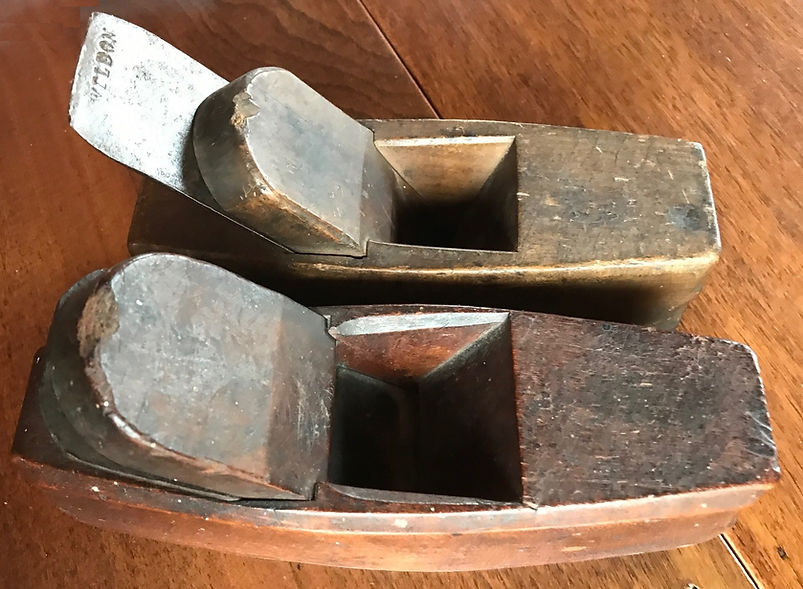
Concluding the A Adams mark(s) and plane assessment, the editor is of the opinion that, while the construction detail differences are subtle, the large mark smoother and the small mark smoother were not made by the same hand or by two generations of craftsmen in the same family ... ie the A Adams marks / planes are not linked ... aside from a common SE New England location.
Additional A Adams planes
A Adams small mark molder, birch, 10".

A Adams small mark joiner, fruitwood. (Additional material in the 18th C jointer plane gallery section.)


